Welcome to the 'New Somerset and Dorset Railway'

The original Somerset and Dorset Railway closed very controversially in 1966. It is time that decision, made in a very different world, was reversed. We now have many councillors, MPs, businesses and individuals living along the line supporting us. Even the Ministry of Transport supports our general aim. The New S&D was formed in 2009 with the aim of rebuilding as much of the route as possible, at the very least the main line from Bath (Britain's only World Heritage City) to Bournemouth (our premier seaside resort); as well as the branches to Wells, Glastonbury and Wimborne. We will achieve this through a mix of lobbying, trackbed purchase and restoration of sections of the route as they become economically viable. With Climate Change, road congestion, capacity constraints on the railways and now Peak Oil firmly on the agenda we are pushing against an open door. We already own Midford just south of Bath, and are restoring Spetisbury under license from DCC, but this is just the start. There are other established groups restoring stations and line at Midsomer Norton and Shillingstone, and the fabulous narrow gauge line near Templevcombe, the Gartell Railway.

There are now FIVE sites being actively restored on the S&D and this blog will follow what goes on at all of them!
Midford - Midsomer Norton - Gartell - Shillingstone - Spetisbury


Our Aim:

Our aim is to use a mix of lobbying, strategic track-bed purchase, fundraising and encouragement and support of groups already preserving sections of the route, as well as working with local and national government, local people, countryside groups and railway enthusiasts (of all types!) To restore sections of the route as they become viable.
Whilst the New S&D will primarily be a modern passenger and freight railway offering state of the art trains and services, we will also restore the infrastructure to the highest standards and encourage steam working and steam specials over all sections of the route, as well as work very closely with existing heritage lines established on the route.

This blog contains my personal views. Anything said here does not necessarily represent the aims or views of any of the groups currently restoring, preserving or operating trains over the Somerset and Dorset Railway!
Showing posts with label electric traction. Show all posts

Wednesday, November 16, 2011

bristol starts to stir


As many of you know I live in the tramway and railway desert of south Bristol. We were supposed to be the terminus of one of Bristol's tram routes but this scheme was sunk (for a while) by Dawn Primorolo, who thankfully is stepping down as an MP at the next election.

Bristol is at last about to get an electrified route to London, and the commuter network in waiting (including the Bristol to Radstock route which will form part of the New S&D and WILL serve parts of south Bristol) is beginning to stir. The following report is basically good news but where's the Portishead route, and where are our trams?? It's a start, but only that ...

Bristol Rail Commuters Put On Fast Track

Tuesday, November 15th 2011 12:00


Longer platforms, faster journey times and more services promised as Network Rail sets up new Bristol and WestCountry unit.

Network Rail has today announced a new unit to control improvements across Bristol and the WestCountry.

It says "Network Rail Western", has been created as part it's drive to give local management the power to make independent funding decisions - to reduce costs and raise value for money, so that the savings could be reinvested in the area.

NRW has cited Bristol as one of THE highest forecast growth in rail passenger demand in the UK, at around 44% by the end of the decade - up from a previous 41% after taking into consideration the future electrification to London - cutting journey times from Bristol to the Capital by around 22minutes.

Part of the plan sees potential redevelopment of land around Temple Meads for more platforms, better car parking and an integrated transport hub. There's also plans to enhance the railway to and from Temple Meads and Filton Abbey Wood to improving journey times.

By the end of 2014, Network Rail Western also sets to achieve at least 93% in punctuality, by tackling cable thefts and implement a robust 7-day railway strategy to minimise disruption during major improvement work.

Network Rail Western will be spending around £400m by 2013 to operate, renew and enhance the 995miles of railway in the new Western region.

Priority schemes over the next two years include:

* £300m to modernise life-expired signalling equipment including those around Bristol so that the infrastructure is compatible with an electrified railway to London.

* £55m to build and design a unique factory train to install electrify the railway.

* £8m to improve journey time between Bristol and Birmingham

* Improvements to journey times between Bristol and Bridgwater, and potentially Plymouth, by enhancing line speeds

* Reducing congestion at Bristol Temple Meads, where around 8.9m passengers enter and exit per year

* Boosting capacity between Dr Days to Filton Abbey Wood by providing a four track railway

* An extra down line platform and passenger area to enable additional fast trains per hour to operate between Bristol and Paddington and also to Parkway after electrification

* The West of England Local Enterprise Partnership (LEP) has recently announced their new Enterprise Zone, known as Temple Quarter, which includes the area of land alongside the former Royal Mail post office site and the large area of disused land leading down to the former Bath Road diesel depot.

The area covers 70 hectares of land with initial estimates suggesting the potential to accommodate over 250 businesses and 17,000 new jobs over a 25-year period. The focus is on creative and digital industries with retail opportunities as part of a wider mixed use development.

The Temple Quarter site is seen as a major gateway that has huge potential to generate jobs and investment for the area that is highly attractive to businesses looking to relocate, demand for transport services from Bristol Temple Meads will significantly increase.

Wednesday, September 28, 2011

sustainability?


Short notice I know but do try to get along to the talk tonight at Avon Valley Railway, 7.30pm - David Cole will talk about the railway's efforts to become more sustainable. The talk is free, and there will be free refreshements as well! Location is Bitton.

I better not go along as I suspect I'd create a little discomfort bringing up points such as use of diesel locos, lack of a genuine public service taking cars and buses off the road etc, but at least the AVR are realising that this issue is going to become of great importance over the coming years. Personally I hope the AVR presses to extend so that eventually they can provide a full passenger and freight service between Bristol and Bath, releasing some capacity from the network line which partly parallels it. They should also be looking into the building of lightweight electric vehicles once a full service is introduced. One day we'll connect with an extended AVR in Bath, so I always follow this line's developments with interest.

Thursday, September 15, 2011

back from switzerland


A few tasters from our week in Switzerland - highlight was a trip over the Montreux-Oberland-Bernoise Railway (MOB). Weather was superb throughout, except on the day we left when the village was shrouded in cloud!

Back to new member sign ups, donations and a plan for Spetisbury!

More to follow on Switzerland and the S&D!
Posted by Picasa

Tuesday, September 06, 2011

death of the diesels


I just caught the end of steam when I was a kid, watching the Brighton-Plymouth at speed over the level crossing at Lyminster, saw a few on Ryde Pier, saw a tank engine somewhere in London and, from a great distance, the trains departing from Waterloo to the west. Everything else I saw was electrics, until one day, somewhere in Battersea, I saw a big green diesel crossing a bridge over the road. I was hooked. These were far better than electrics and were modern, so much better than steam!

But I think we all know now that diesel locomotives' days are numbered. As the price of oil starts to rocket the railway companies will quickly feel the pinch, even though their supplies will obviously be prioritised over the private motorist (who will be finished). There'll be a rush to electrify but will the money and, more importantly, the skills be there to do it in time? I doubt it.

But there is of course an obvious alternative to electric locomotives - steam! Not the lumbering old polluting and high maintenance machines of old of course, but sleek, clean and fast woodburners, using a sustainable energy source and providing an excellent power source for the tens of thousands of extra trains we're going to need in the future to keep us going. Their USP will be their use of simple technology and also being completely sustainable. They'll have the other advantage that even the old steam engines used to have - longevity. They could easily be built to last 50 or even 100 years or longer, with standardised parts that can be recovered and recycled when the locomotives finally wear out.

I suspect that just about the whole network will be eventually electrified, that's the current network plus the reversed Beeching routes, but local railways and many industrial lines may well find that steam is the cheapest and easiest option. We really are about to enter a new age of steam.

And what of the diesel locomotive? It's doomed. There won't even be the option of running them on preserved routes, diesel for public transport simply won't be available. I suspect the last of the oil will be snapped up by the military, by chemical and fertilizer companies and, of course, by the airlines. And even then it won't last long.

So get out there and photograph these magnificent creations. We may not see their like again ever, or at least for 150 million years, when oil may once again be available for a century or two ...
Posted by Picasa

Tuesday, August 16, 2011

worth it


Posted by Picasa
The usual suspects are already whinging about rising rail fares, yet they are only being set at 3% above PRI over the next three years. This is a genuine rise of around 10%. Is it such a big deal?

So what will we be getting? 2300 new carriages for a start. Completion of Cross Rail. Electrification from Bristol to London. And an awful lot more. The railways are absolutely buzzing at the moment with ridership at almost an historical high. Success tends to come at a cost. Does anyone seriously believe that motoring costs will only rise 10% over the next three years? And air fares? I'd be surprised if they keep under 50%! It's all relative. Simply giving up and selling your car releases huge amounts of cash, buy a bike and generally travel less (by train of course) and you'll save thousands every year. You could even afford to go first class - we do most of the time!

Apparently a million people have given up driving over the last year, citing the 'high' cost of fuel!! The roads certainly seem quieter. The reduced number of drivers will lead to inevitabe tax and duty rises to cover the income shortfall (only slightly offset by reduced wear and tear), setting up a virtuous circle of less car and lorry use and more use of rail. And 19% less youngsters are taking driving lessons, a brilliant fact!

Forget the 1970s attitudes. Rail, like gold and the Swiss Franc, are on a high. And success costs that little bit more. It's a price well worth paying!

Saturday, June 25, 2011

scotland leads the way

Of course only an idiot would now say that the Beeching cuts were necessary. We need to forget that time and get on with rebuilding our rail network - firstly to reverse all the Beeching cuts, then start filling in the gaps with interurbans, light railways and industrial routes, ready for an oilless future. Not only does rebuilding and extending the network need to happen quickly but so does electrification of the entire rail network - and yes I do include heritage routes, narrow gauge lines etc!

Scotland is starting the process, albieit very slowly. Take a listen to this http://www.bbc.co.uk/iplayer/episode/b0120783/Reversing_Dr_Beeching/

Sunday, May 08, 2011

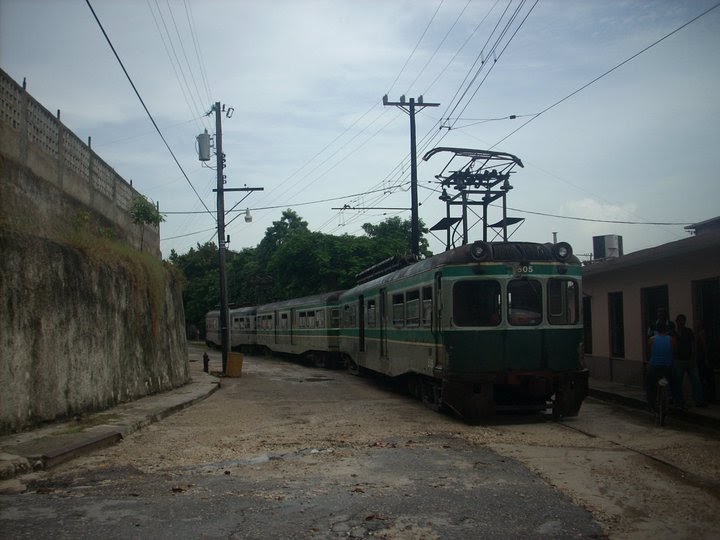
havana 2011

(Photo © Kim Newbold)

We are taking a two week break in Havana from next Tuesday so don't expect any posts for a couple of weeks. The internet's not generally available in Cuba so I will be just about cut off from the real world.

One thing I'm really looking forward to doing is travelling on the Hershey Railway which is the only electric interurban tramway in Cuba - it runs for about 90km.

No doubt I'll have more pics and info on my return.


Friday, March 25, 2011

easy tracklaying!


My afternoon involved laying a panel of track on my garden railway - the weather was too good not to do it! The line is only 7 1/4" gauge and just four track panels long (my previous garden was a lot larger!) but now it's complete I'm thinking about getting an electric loco charged via a solar panel. As always with me the line will serve a purpose helping to move stuff around the garden and giving it a focal point.

This took just an hour to do!
Posted by Picasa

Thursday, July 29, 2010

perpetual motion?


Not quite - but a neat way of using railway infrastructure to generate the power needed to run the trains!

(Thanks to David Bailey for the story)


As of Sunday, the world’s largest stand alone integrated photovoltaic project was pumping out power into the grid. The building integrated PV system is located on the roof of the recently completed Hongqiao Rail Station in Shanghai. With 20,000 panels, the 61,000 sq m roof system is expected to produce 6.3 million kilowatt-hours (kwh) of electricity per year, which could power 12,000 Shanghai households.

Hongqiao Station is the newest high speed rail station on the Beijing-Shanghai rail line. The station was completed and operational on July 1st and a mere two weeks later, its large solar system went online as well. Installed on the awnings of both sides of the station, the 6.68 MW photovoltaic system has already produced 300,000 kWh during testing for these last two weeks.

This new solar project is meant as a pilot project to help spur on the advancement of solar power in China as well as to encourage the construction of eco-friendly rail stations that are planned for China’s high speed rail network. At a cost of 160 million yuan ($23.6 million), the new solar system will also help reduce carbon emissions by 6,600 tons and cut coal consumption by 2,254 tons

Saturday, May 29, 2010

power ...

Heidelberger Strassenbahnen: Eine Dokumentation uber die Heidelberger Strassen- und Bergbahn AG = Tramways of Heidelberg (Germany) (Archiv) (German Edition)
Tramway and Light Railway Atlas 1996: Germany - Tramway, U-Bahn, S-Bahn, Trolleybus
Schwandl's Tram Atlas Deutschland: Detailed Maps of All German Tram, Light Rail and Underground Networks (English and German Edition)

 
The Parry People Mover uses a flywheel to store energy with no overhead wires or conductor rail needed.


Modern trams use lightweight catenary.


Classic Southern Region conductor rail - cheap but dangerous!


Heavier style main line catenary - here used on a roadside line in Switzerland.

Anna-Jayne has just found this article which could provide the ideal power system for the New S&D - buried electric supply meaning that the system is totally safe (unlike conductor rails), cheap (no expensive masts) and aestetically pleasing (no external presence). This gets easier as each week passes!

Bombardier to test wireless trams in Augsburg

26 May 2010

GERMANY: The Primove induction-based catenary-free electrification system developed by Bombardier Transportation is to be piloted on the tram network in Augsburg, the manufacturer announced on May 26.

Formally unveiled at Bombardier's Bautzen factory in January 2009, Primove uses cable buried beneath the track to produce a magnetic fields which induces electric current for traction power in pick-up coils mounted underneath the vehicle.

It will be installed on a 0·8 km branch from Augsburg Line 3 which serves the city's exhibition centre. This will enable Bombardier to demonstrate the technical capabilities and electromagnetic compatibility of Primove, which is a potential competitor for Alstom's APS ground-level power supply in locations where overhead electrification is considered undesirable.

'Our expectation for the Primove pilot project is to gain further insights into new developments in energy management and energy savings in tramway operations', said Stadtwerke Augsburg Verkehrs Managing Director Norbert Walter. 'We will also co-operate with the Augsburg University of Applied Sciences'.

Bombardier is currently supplying Augsburg with 27 Flexity Outlook trams. The first arrived last year and deliveries will run to the end of this year.


Source
Posted by Picasa

Monday, August 24, 2009

back from switzerland


A few teaser pictures from this weekend's trip to Switzerland - content to follow tomorrow!
Posted by Picasa

Wednesday, August 19, 2009

swiss interval


We're off to Switzerland tomorrow for the Nuits des Fees in Leysin. If you feel that being a railway enthusiast is a bit socially isolating you're blaming the wrong thing! I discovered Leysin in the early 70s, it was on the end of a metre gauge line from Aigle where, incredibly, three narrow gauge lines started their journeys up into the mountains, all using street running in Aigle. Not a lot has changed in the last three decades although the AOMC no longer uses it's street running section having built a new line alongside the main line. A few years later I spent nearly a year there, both summer and winter, discovered skiing and also managed to visit just about every line in Switzerland. I still have friends from my Leysin days.

What Switzerland taught me is that railways can easily become the prime form of transport if it has the proper support within the country. Since my first visits new lines have been built throughout Switzerland, many employing extremely long tunnels. Nearly all lines are electrified, using hydro electricity so are well up in the sustainability rankings.

Leysin, a town about a fifth the size of Midsomer Norton, has FOUR stations and trains at least every hour.

So I'll be away for five days. I may be able to post when I'm away but don't count on it. But don't worry - this blog has been running for over three years and a delve into the archives should be very rewarding. Otherwise why not visit one of the S&D websites (on the sidebar)?

Who knows, I may even come back more fired up than ever!
Posted by Picasa

Monday, April 20, 2009

a lesson from Austria


Berg Isel station.


The tramride through the woods.


Igls station.

Years ago there was a rural tramway in the Black Country which ran up to a beauty spot called Kinver. It was a popular and busy route which only closed (in 1930!) because the parent tramway company, principally an urban set up, was closing down. If open today it would be a major tourist attraction.

In Austria they do things differently! The little tramway from Bergisel on the Innsbruck network up to Igls is like an Austrian Kinver Light Railway, complete with a bit of street and roadside running, followed by a wonderful squealy trip through the woods, up to a real station in Igls. Trams run every hour. Don't miss it!

Apparently the entire route of the Kinver Valley line remains. Why not bring tourist trams back to the Black Country? If Austria can do it why can't we?
Posted by Picasa