Welcome to the 'New Somerset and Dorset Railway'

The original Somerset and Dorset Railway closed very controversially in 1966. It is time that decision, made in a very different world, was reversed. We now have many councillors, MPs, businesses and individuals living along the line supporting us. Even the Ministry of Transport supports our general aim. The New S&D was formed in 2009 with the aim of rebuilding as much of the route as possible, at the very least the main line from Bath (Britain's only World Heritage City) to Bournemouth (our premier seaside resort); as well as the branches to Wells, Glastonbury and Wimborne. We will achieve this through a mix of lobbying, trackbed purchase and restoration of sections of the route as they become economically viable. With Climate Change, road congestion, capacity constraints on the railways and now Peak Oil firmly on the agenda we are pushing against an open door. We already own Midford just south of Bath, and are restoring Spetisbury under license from DCC, but this is just the start. There are other established groups restoring stations and line at Midsomer Norton and Shillingstone, and the fabulous narrow gauge line near Templevcombe, the Gartell Railway.

There are now FIVE sites being actively restored on the S&D and this blog will follow what goes on at all of them!
Midford - Midsomer Norton - Gartell - Shillingstone - Spetisbury


Our Aim:

Our aim is to use a mix of lobbying, strategic track-bed purchase, fundraising and encouragement and support of groups already preserving sections of the route, as well as working with local and national government, local people, countryside groups and railway enthusiasts (of all types!) To restore sections of the route as they become viable.
Whilst the New S&D will primarily be a modern passenger and freight railway offering state of the art trains and services, we will also restore the infrastructure to the highest standards and encourage steam working and steam specials over all sections of the route, as well as work very closely with existing heritage lines established on the route.

This blog contains my personal views. Anything said here does not necessarily represent the aims or views of any of the groups currently restoring, preserving or operating trains over the Somerset and Dorset Railway!
Showing posts with label trams. Show all posts

Monday, March 05, 2012

the beginning of the end?


This is an interesting intro to a radio programme as it actually brings up some fresh ideas on why car use is falling. It's not just cost, but also environmental awareness and a creeping feeling that cars are simply no longer cool. They are now seen as safe and fuddy-duddy, quite a contrast to the big American cars of the 50s or the classic British cars of the 60s (which I still love). I think you can extrapolate from this that the doomed electric, hybrid and other exotic fuel cars which may or not appear will be equally - or even more - uncool and safe.

Yet at the same time trams and trains are seen as increasingly cool, everybody wants them and everyone wants to use them. Even the old hobby of trainspotting's current manifestation as railway enthusiasm is cool. I wonder why?

Thanks to David Robins for the link!

The car was once the symbol of youthful cool. From James Dean through Steve McQueen to Ayrton Senna the car was a symbol of freedom, daring and sexual allure. Today the young of the western world have turned their back on the car. Half of American 17-year-olds have a driver's licence today compared with three-quarters in 1998 and in Europe car sales are down whilst public transport use is up.
Is it simply that insurance costs have rocketed for young drivers? Is it because the young remain in education for longer? Are our youth becoming more environmentally aware or is it because cars have become safe, reliable and downright dull?
In 'Costing the Earth' Tom Heap takes to the road from the Streets of San Francisco to the inner ring roads of the West Midlands to find out if the age of the car is coming to an end. He meets the marketing men, the manufacturers and the innovators struggling to retain a place in our affections for the motor car.
Producer: Martin Poyntz-Roberts.

Broadcasts

  1. Tue 6 Mar 2012
    15:30
  2. Wed 7 Mar 2012
    21:00

Wednesday, December 14, 2011

slap


I rather underestimated the jetlag, the pile of work waiting for me and the sheer amount of time a new kitten requires, so sorry for the lack of posts. Hopefully I'll be able to get on with them tomorrow!

There's plenty on modern transport, Bristol's upcoming fake trams and great news from Spetisbury to come!
Posted by Picasa

Wednesday, November 16, 2011

bristol starts to stir


As many of you know I live in the tramway and railway desert of south Bristol. We were supposed to be the terminus of one of Bristol's tram routes but this scheme was sunk (for a while) by Dawn Primorolo, who thankfully is stepping down as an MP at the next election.

Bristol is at last about to get an electrified route to London, and the commuter network in waiting (including the Bristol to Radstock route which will form part of the New S&D and WILL serve parts of south Bristol) is beginning to stir. The following report is basically good news but where's the Portishead route, and where are our trams?? It's a start, but only that ...

Bristol Rail Commuters Put On Fast Track

Tuesday, November 15th 2011 12:00


Longer platforms, faster journey times and more services promised as Network Rail sets up new Bristol and WestCountry unit.

Network Rail has today announced a new unit to control improvements across Bristol and the WestCountry.

It says "Network Rail Western", has been created as part it's drive to give local management the power to make independent funding decisions - to reduce costs and raise value for money, so that the savings could be reinvested in the area.

NRW has cited Bristol as one of THE highest forecast growth in rail passenger demand in the UK, at around 44% by the end of the decade - up from a previous 41% after taking into consideration the future electrification to London - cutting journey times from Bristol to the Capital by around 22minutes.

Part of the plan sees potential redevelopment of land around Temple Meads for more platforms, better car parking and an integrated transport hub. There's also plans to enhance the railway to and from Temple Meads and Filton Abbey Wood to improving journey times.

By the end of 2014, Network Rail Western also sets to achieve at least 93% in punctuality, by tackling cable thefts and implement a robust 7-day railway strategy to minimise disruption during major improvement work.

Network Rail Western will be spending around £400m by 2013 to operate, renew and enhance the 995miles of railway in the new Western region.

Priority schemes over the next two years include:

* £300m to modernise life-expired signalling equipment including those around Bristol so that the infrastructure is compatible with an electrified railway to London.

* £55m to build and design a unique factory train to install electrify the railway.

* £8m to improve journey time between Bristol and Birmingham

* Improvements to journey times between Bristol and Bridgwater, and potentially Plymouth, by enhancing line speeds

* Reducing congestion at Bristol Temple Meads, where around 8.9m passengers enter and exit per year

* Boosting capacity between Dr Days to Filton Abbey Wood by providing a four track railway

* An extra down line platform and passenger area to enable additional fast trains per hour to operate between Bristol and Paddington and also to Parkway after electrification

* The West of England Local Enterprise Partnership (LEP) has recently announced their new Enterprise Zone, known as Temple Quarter, which includes the area of land alongside the former Royal Mail post office site and the large area of disused land leading down to the former Bath Road diesel depot.

The area covers 70 hectares of land with initial estimates suggesting the potential to accommodate over 250 businesses and 17,000 new jobs over a 25-year period. The focus is on creative and digital industries with retail opportunities as part of a wider mixed use development.

The Temple Quarter site is seen as a major gateway that has huge potential to generate jobs and investment for the area that is highly attractive to businesses looking to relocate, demand for transport services from Bristol Temple Meads will significantly increase.

Tuesday, April 12, 2011

the US ahead of the UK in modern transport - who would have believed it?

The USA, former home of the automobile has actually pushed AHEAD of the UK in developing 21st ce ntury transport. In addition to building dozens of new tramways in the last twenty years or so they have just now started building trams again.

It's time the UK woke up tpo the amazing opportunities opening up for the building and operating of modern transport solutions - both light and heavy rail - as the oil price escalates.

This is from the US Dept of Transportation's own blog.

United Streetcar putting Americans to work


When you watch our latest video, "Transporting America: United Streetcar," you'll see the next generation of transportation. You'll see transit investments from the Department of Transportation helping people get where they need to go without breaking the bank. And you'll see a company out-innovating and out-building its foreign competition while creating jobs for American workers.


The streetcars rolling through Portland, Oregon, are helping commuters beat the rising cost of refueling their cars and vans and trucks. And, as rising gas prices take a bigger bite out of family budgets, other communities are looking to ease that bite through similar transportation options.

As commuter Jim Winkle says in the video, "It's made a huge difference."


That's why the Department of Transportation has supported streetcar projects in communities like Portland across America. From Charlotte, North Carolina, and Washington, DC, to Tucson, Arizona, and Dallas, Texas, grants from the Federal Transit Administration are helping jump-start the American streetcar renaissance.


United Streetcar president Chandra Brown agrees: "The Department of Transportation has been a true partner as the streetcar industry has developed. Without their assistance, we could not have made the private investment to make this new industry successful."


That's good news for commuters and their families. It's also good news for American workers because, at United Streetcar, they're manufacturing the first American streetcars in more than 50 years.


And we mean "American." The cars rolling out of United Streetcar have the highest percentage of American parts and labor of any streetcar in the last 50 years. That means United Streetcar's innovation is creating an economic ripple effect, providing business for an all-American supply chain of more than 200 different vendors in 20-plus states across the U.S.


I love the idea of DOT grants helping create American jobs, and I love the idea of helping American families with options to ease the pinch they feel at the pump. But there's also the pride I hear in workers--like welder Steve Goodman and construction foreman Casey Peacock--who know that for the first time in more than 50 years America can build its own streetcars.


And not only build our own streetcars--this company is bold enough to take on its foreign competitors by planning to export the cars they make.


President Obama has challenged Americans to dream big and build big. United Streetcar has risen to that challenge, and they’re doing it all with American parts, labor, and ingenuity. That means less congestion on our roads, more jobs for American workers, and a future we are prepared to win.

Video <here

Friday, September 10, 2010

perchance we are all waking up!


Photo courtesy Welsh Highland Railway.

FACEBOOK - RAIL THING - NARROW GAUGE RAILS

Narrow Gauge page on the Rail Thing website.

Look carefully at the photo above. It says a lot about the way things are going.

The lead loco is the new build 'Lyd', an authentic copy of the elegant and charming Lynton and Barnstaple Railway loco.

The Lynton and Barnstaple closed in 1935. It was a digraceful closure, robbing southern England of its second most charismatic railway. It served a prime holiday area and had it survived a few more years would now be one of the biggest and most profitable tourist attractions in Britain. On the buffer stop at Barnstaple Town some incredibly far sighted admirer placed a wreath stating 'Perchance it is not dead but merely sleepeth'. I suspect it was partly this image of optimism that encouraged brave preservationists to suggest in the 70s that the L&B should be rebuilt. The best thing is that the small start up group has over the years developed into an ambitious affair which intends to eventually restore the whole line, and in fact even extend it in Lynton to make it a more appropriate public service for the 21st century. Of course the original closure of the L&B was idiotic, it was a visionary line that has an even bigger role to play in the 21st century than it ever did in the 19th and 20th. Its time has come, and now one of its engines has returned from the past.

The second fascinating aspect of this picture is the track. Note that it's laid tramway style. This is the start of the section of line in Porthmadog that runs as a tramway. Who would have thought back in the 60s and 70s that this could ever happen? Again trams are possibly the most iconic 21st century transport system imaginable, and whilst this is not a tram or tramway in any normal sense of the word the return of rails to streets in other parts of the UK has made their adoption in a small Welsh town possible. It may well be that parts of the S&D in the future use tram like tracks in places, to save huge demolition bills. The Welsh Highland Railway has now been fully rebuilt giving tourists a modern way to explore the heart of Snowdonia. This is not preservation as such, but the first wave of a huge railway revival in Britain.
Posted by Picasa

Saturday, May 29, 2010

power ...

Heidelberger Strassenbahnen: Eine Dokumentation uber die Heidelberger Strassen- und Bergbahn AG = Tramways of Heidelberg (Germany) (Archiv) (German Edition)
Tramway and Light Railway Atlas 1996: Germany - Tramway, U-Bahn, S-Bahn, Trolleybus
Schwandl's Tram Atlas Deutschland: Detailed Maps of All German Tram, Light Rail and Underground Networks (English and German Edition)

 
The Parry People Mover uses a flywheel to store energy with no overhead wires or conductor rail needed.


Modern trams use lightweight catenary.


Classic Southern Region conductor rail - cheap but dangerous!


Heavier style main line catenary - here used on a roadside line in Switzerland.

Anna-Jayne has just found this article which could provide the ideal power system for the New S&D - buried electric supply meaning that the system is totally safe (unlike conductor rails), cheap (no expensive masts) and aestetically pleasing (no external presence). This gets easier as each week passes!

Bombardier to test wireless trams in Augsburg

26 May 2010

GERMANY: The Primove induction-based catenary-free electrification system developed by Bombardier Transportation is to be piloted on the tram network in Augsburg, the manufacturer announced on May 26.

Formally unveiled at Bombardier's Bautzen factory in January 2009, Primove uses cable buried beneath the track to produce a magnetic fields which induces electric current for traction power in pick-up coils mounted underneath the vehicle.

It will be installed on a 0·8 km branch from Augsburg Line 3 which serves the city's exhibition centre. This will enable Bombardier to demonstrate the technical capabilities and electromagnetic compatibility of Primove, which is a potential competitor for Alstom's APS ground-level power supply in locations where overhead electrification is considered undesirable.

'Our expectation for the Primove pilot project is to gain further insights into new developments in energy management and energy savings in tramway operations', said Stadtwerke Augsburg Verkehrs Managing Director Norbert Walter. 'We will also co-operate with the Augsburg University of Applied Sciences'.

Bombardier is currently supplying Augsburg with 27 Flexity Outlook trams. The first arrived last year and deliveries will run to the end of this year.


Source
Posted by Picasa

Sunday, March 14, 2010

transport madness


Blot on the landscape - and what for?


How modern transport should blend in!

My in box has been full of stuff about the laughable Cambridge Guided Busway. This extraordinary white elephant has still not been opened, and costs are still spiralling. Will we ever know what this idiocy was ever about? Or perhaps it's just a very long-winded way of preserving the trackbed without letting the Peak Oil cat out of the bag?

The simple fact is that this piece of essential transport infrastructure needs to be rebuilt as, preferably, a heavy railway or, at the very least, a modern interurban tramway. The cost would be around 30%/15% and ridership would be far higher. Fuel use would be around 25% of that for the buses and who knows what the maintenance costs are going to be?

This is why cold hard economics needs to be applied to transport investment rather than agenda-laden posturing by idiotic politicians who are desperate to keep Peak Oil below the radar.

We all know that buses are considered to be the most unpopular form of public transport. It is almost impossible to prise people out of their cars to use them, whereas many car drivers are happy to switch to trams which are seen as modern, clean, fast and efficient. Buses even try to disguise themselves as trams to tempt people out of their cars by being given smart modern lines, but it won't work. Passengers need the added security of a FIXED route to convince them that the new transport system is here for the foreseeable future, rather than buses which use pubic roads. Okay, the concrete tram-like tracks of the guided busway suggest a similar commitment, but we can see that they are just a stage towards modern transport - ie the eventual replacement of the method of propulsion to overhead wire (trolleybus fashion) and the eventual replacement of concrete by steel rail (giving a 75% fuel, efficiency and cost saving). But why not just build the railway/tramway in the first place?

People locally HATE this monstrosity and will boycott it until they get their trams or trains. I fully expect to be reporting on the replacement of this joke by a modern tramway or railway within ten years.

The extraordinary thing is that this lunacy is being threatened on two other essential rail routes - Fareham-Gosport and Luton-Dunstable!!
Posted by Picasa

Sunday, March 07, 2010

back to barcelona


Some shots from Barcelona's very new tramway, the Trambaix. These are shots from the northern network of lines 4, 5 and 6. There is also an unconnected (and slightly less new) network to the south of the city which is also 3 routes. Interestingly both routes terminate on the same diagonal road that intersects the city but with about 2 miles between the routes. No doubt the network will expand enormously in the future and the lines will link up. It would be great to see modern trams rather than buses running along La Rambla and the waterside.

Britain's lagging years behind continental Europe on the installation of modern, sustainable transport systems, but we won't always be so backwards! I suspect that as time goes by the distinction between tram and train will continue to blur and that the New S&D will meet tramways at many points on our route, and trams may even work over some sections of our network. Alternatively we may need to run rails in the streets where building work has blocked our line and the alternatives are too expensive to justify, which will mean running heavy passenger and freight trains through the streets, as in Switzerland and the USA. Who knows?
Posted by Picasa

Wednesday, March 03, 2010

tibidabo


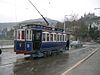
It's not often I stumble on a tramway or railway that I don't now about, but this was a genuine surprise in Barcelona. Now Barcelona has recently built an excellent new tram system, in two discrete parts, but this is a survival from the original Barcelona tram network, which was unusual in that it ran double-deckers. In fact until quite recently it was, amazingly, the ONLY tramway in mainland Spain.

It runs for about a mile from Ave. Tibidabo to the foot of the funicular that continues up to the funfair at the top. We caught it in the rain on a Sunday afternoon, and despite running services in convoy the trams were packed!

I would of course prefer to see a modern tramway, but this does serve a genuine transport need and has done so since 1901. Hopefully in the future it will once again be connected to a city wide tramway system.

(To those who complain when I add foreign pieces to this blog, remember that a search for 'Tibidabo' will bring people who have no idea that the New S&D exists to this blog!)

More info (from Wikipedia)

The Tramvia Blau (Catalan for "blue tramway") is one of Barcelona's three tram systems. It is a 1.276 kilometres (0.793 mi) long heritage streetcar line serving a hilly area of the Sarrià-Sant Gervasi district between the terminus of FGC Barcelona Metro L7 and the Funicular del Tibidabo.
The Tramvia Blau is operated by Transports Metropolitans de Barcelona (TMB) but it is not part of Autoritat del Transport Metropolità (ATM) integrated fare network. Tickets must be purchased from the tram conductor.
The Tramvia Blau is one of only two first generation tramways to survive in Spain, along with the Tranvía de Sóller on the island of Majorca.

History

The line was built at the instigation of Sr.Salvador Andreu, who was building a residential project around the axis of the Avenida Tibidabo, and was inaugurated in 1901. The line connected at Plaça Kennedy with trams of Barcelona's city system, but was independently owned. The line's own distinctive blue livery soon led to it becoming known as the Tramvia Blau.
The line suffered several changes in 1922 and 1958.
In 1954, line 7 of the Barcelona Metro was opened to Avinguda Tibidabo station under Plaça Kennedy, providing another connection to central Barcelona. However in the 1960s the city trams were withdrawn from Plaça Kennedy, cutting the Tramvia Blau off from the city network.
In 1971 the remaining tram routes of the Tranvías de Barcelona company were closed. However, the separately owned Tramvia Blau remained in operation. It continued in private ownership until 1979, when it was taken over by the city, who continued to operate it. Between 1971 and 2004, when the second generation Trambaix and Trambesòs lines opened, it was the only tram route in the city.

Operation

Infrastructure


Typical Tramvia Blau street track
The Tramvia Blau is 1.276 kilometres (0.793 mi) long, climbing a vertical distance of 93 metres (305 ft) at a maximum gradient of 8%. It is constructed to 1,435 mm (4 ft 8 12 in) gauge and is double track, apart from single track stub terminals at each terminus. It runs in the Avinguda Tibidabo throughout, and is not segregated from other traffic.
The line's depot is accessed by some 100 metres (330 ft) of single track, which is not used in passenger service. The depot branch joins the main line near its midpoint, adjacent to the bridge carrying the Avinguda Tibidabo over the Ronda de Dalt.
The line serves the following stops:
UphillDownhill
  • Plaça Kennedy
  • Román Macaya
  • Josep Garí
  • Lluís Muntadas
  • Font del Racó
  • Plaça del Doctor Andreu
  • Plaça del Doctor Andreu
  • Carrer número 15
  • Adrià Margarit
  • Bosch i Alsina
  • Josep Mª Florensa
  • Plaça Kennedy

Tram fleet


Cars 2, 7 and 129 posed in front of the depot in 2005. Car 7 is in its pre-rebuilt condition, as can be seen by comparison with the image at the head of this article.
The line is operated with a fleet of seven historic tram cars:
ImageNumberYearNotes
21901The only survivor of a class of four trams built for the opening of the Tramvia Blau. Is operable, but only used on special occasions.
Tramvia Blau.JPG5,8,101904Members of a further class of six four-wheeled trams built for service on the Tramvia Blau. The cars are double-ended, with two doors on each side with manually operated gates. Each car has a capacity for 32 seated passengers, and has a maximum speed of 13 kilometres per hour (8.1 mph).
Old tram at Barcelona pic03.JPG6,71904Members of the same class as 5, 8 and 10, but rebuilt in 2005 to 2006. The rebuilt cars retain their original layout and propulsion, with the addition of hydraulic brakes.
Old tram at Barcelona pic09.JPG1291906Open car originally built for the Barcelona city system. Restored in 1986, using the truck from Tramvia Blau tram 9, of the same class as 5-8 and 10. Painted in the traditional red of the Barcelona city system rather than the blue of the Tramvia Blau.

Thursday, February 25, 2010

jurassic park


The past.


The future.

This extraordinary load of old tosh appeared today on AOL.

Road congestion 'could rise by 37%'

Britain's roads need more investment, the Road Users' Alliance has said.

Traffic congestion will rise by 37% if the current "minimal levels of investment" in roads continues for the next 15 years, a report has said.

By 2025, drivers could be wasting 656 million hours a year - the equivalent of 75,000 years - sitting in traffic jams, the Road Users' Alliance (RUA) added.

"Under-investment in the strategic road network has left the UK with a transport system which is uncompetitive, congested, vulnerable to incident and inadequate to meet the future needs of the economy," the report concluded.

The RUA said that the UK's investment in new motorway capacity was among the lowest in Europe, with no new motorway miles being created in 2007 and 2008.

It added that while £47 billion a year was collected in road user taxes, only £4 billion was invested in new road capacity.
The survey also revealed that the major road network grew by 1% between 1998 and 2008, but had to cope with traffic growth of almost 10%.

Travel by car remained the most popular form of transport, with 92% of Britain's passenger transport taking place by road and 70% of commuting and business journeys made by car.

RUA director Tim Green said: "Road users have for too long been regarded as wallets on wheels, providing an endless stream of revenue for the Government to spend on anything except the road network.

"Hard choices face whichever party leader finds himself in Downing Street after the election. Will limited funds be spent on rail, which moves fewer than 10% of UK passengers, or invested in the transport mode which makes the biggest contribution to the UK's prosperity and quality of life - the road network?"


Well, I know dinosaurs had tiny brains but this goes beyond that! Why do people so desperately want to hang on to the twentieth century? Was it really that good?

All through this piece the clues are there. If any government seriously believed roads DID have a future then obviously this investment would be made - it would be madness NOT to invest in the road network. But we know that roads don't have a future - no amount of scrabbling about trying to replace oil is ever going to produce the levels of traffic we have today. There's no possibility of road transport being used for freight in the future -except for very short runs where private sidings, goods lines or goods tramways haven't yet been built. All long distance travel will quickly switch from road (and air) to rail. Private cars will become really scarce and the roads themselves will begin to physically vanish from the landscape, apart from those adopted by Sustrans, horse riders and walkers. This is the reality and these mugs at the anachronistic Road Users' Alliance have found themselves on the wrong side of history.

I almost feel sorry for them!
Posted by Picasa

Wednesday, February 24, 2010

barcelona


A few tasters from Barcelona - needless to say I'll be covering the visit in more detail over coming days.

Loads also happening on the S&D front with station developments and a bit of a rush of new members!

Keep watching and reading ...
Posted by Picasa

Thursday, February 18, 2010

small break


I'll be away for a few days - hopefully enjoying the comparitive warmth of Barcelona. What will definitely be on the cards is modern public transport - Barcelona has been busy building new tram routes since 2004, unlike Bristol, Bath and Bournemouth who still insist on looking to the past for 'solutions' (buses!!) rather than trams.

Had a fantastic new joiner today, who was born in 1912 and remembers seeing the last Pines travel through Broadstone when he was playing golf there. He's 97 or 98 and had the foresight to take out a three year membership! Let's work together so we can show him something concrete in those three years ...
Posted by Picasa

Thursday, October 08, 2009

majorca : 3


The only (currently) working tramway on Majorca is the 4km line from Soller to Port de Soller. This is a very busy line and two or three trams (all pulling up to 3 trailers) work each service.

The line starts by Soller railway station (the oldest railway building in the world!), runs across the town square brushing the restaurant tables, does a bit of street running, then cuts through the town past back gardens before joining the roadside just outside the port for the final stretch right alongside the sea.

The trams are packed even out of season. There is no way a bus would carry similar loads or have a tenth of the appeal. And all worked by electricity and mainly off the road. The trams are ancient but in very good shape. This is real sustainable transport and at €4 per single journey no doubt very profitable!

Trams are due to make a comeback in Palma very soon - more tomorrow.
Posted by Picasa