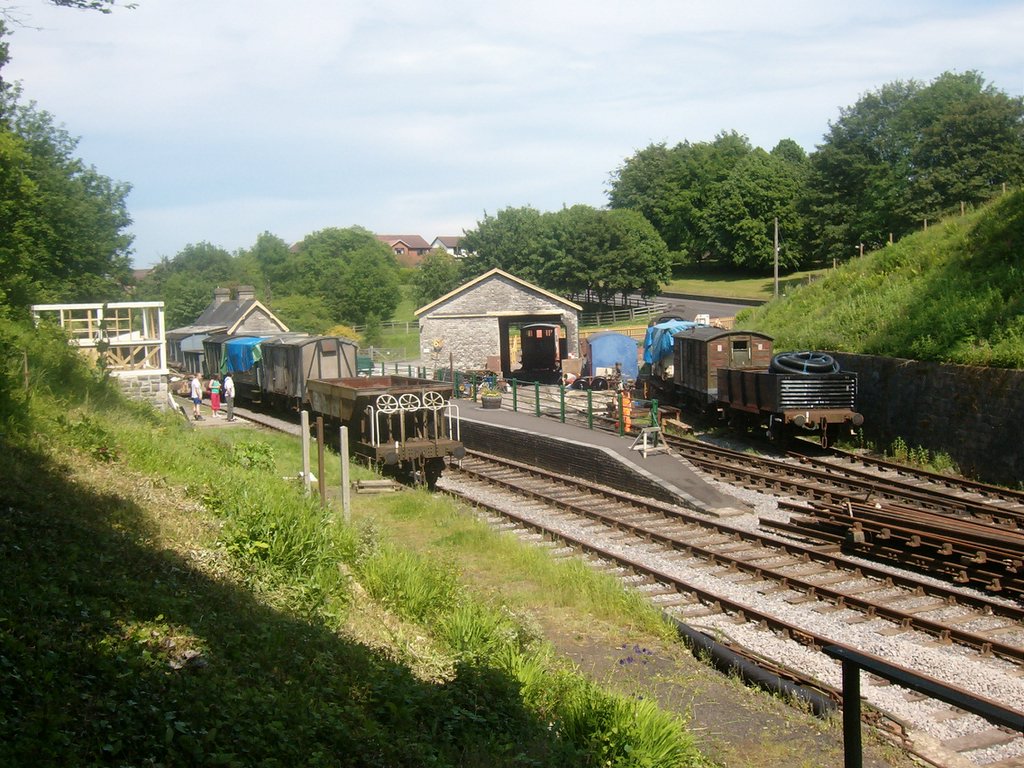
It seems odd that it’s taken forty years for the reversal of the idiotic closure of the S&D to start, and it’s worth looking at some of the possible reasons why.
There’s a story (surely apocryphal) that the whole S&D was offered to anyone interested in 1966 for £50,000! That’s line, stations, signalling, the lot. Even if true would a privately-owned S&D have been viable back in the sixties? The preservation movement was in its infancy, rail was (incredibly) seen as a dying technology, and marketing was unheard of. And at the same time steam was still reasonably common on British Railways, so steam on the S&D wouldn’t have been that much of a novelty. On top of the £50,000 locos and stock would have had to be found, and at that time about the longest preserved line was the Festiniog at 7 miles, the longest standard gauge was the Bluebell at 4 miles. A 100-mile preserved line would have been impossible to run economically - in 1966.
As the sixties became the seventies rail preservation was beginning to find its feet, the Dart Valley and Keighley and Worth Valley were added to the small list of standard gauge lines, and a small preservation set-up was emerging at Radstock, with the seemingly very reasonable and easily-achievable plan to restore the (in-situ) line to Writhlington.
Its failure in the anti-rail 70s surely left a bit of a cloud hanging over the S&D. Attempts (mainly pipe-dreams) to set up other schemes all fell through, without even laying track. The 80s were the real low-point for the S&D, not an inch of track remained and the clock was ticking.
So how could the finest line in the country be allowed to reach such a state? Surely with the huge love and support of rail enthusiasts and local residents at least part of the S&D could have been reinstated, even if only as a tourist attraction? Less worthy lines were being restored all over the country, the Great Central was restoring a double-track main line, the West Somerset turned a decaying branch line into a 20-mile plus tourist trap, even once empty trackbeds were being restored.
Was it the sheer magic of the S&D that frightened people off? Surely those coffin-chasers in the 60s actually quite liked the idea of being the ’last ever’ passengers on the line, there was perhaps a poignant grandeur in decaying stations fading in the mist, the ‘Withered Arm’ generation prefering the easy route of fondly remembering the recent past rather than facing up to the sheer hard work of restoring one of those dead routes? Perhaps they still see the next generation, those of us born too late to travel on and know the original S&D, as somehow inferior to them? Or perhaps there were simply too many other distractions - established steam railways, music, women, cheap sangria etc?
The world has changed so much in the last thirty years that perhaps it’s difficult for any of us to really get into that downbeat mindset any longer. Rail is in the ascendant, roads are coughing their last as the oil runs out, people want to live quieter, friendlier, more connected lives. Doors are opening for us all along the S&D.
Perhaps the S&D needed that period of temporary closure from 1966 to 2007 to gain an insurmountable mythic status where the iconography of Ivo Peters melds with the pathos of Jeffery Grayer, where Mike Arlett’s dulcet if somewhat pessimistic tones are replaced by the guitars of Arctic Monkeys to transform a whisper into a shout that ‘we are back, and this time it’s for good!’