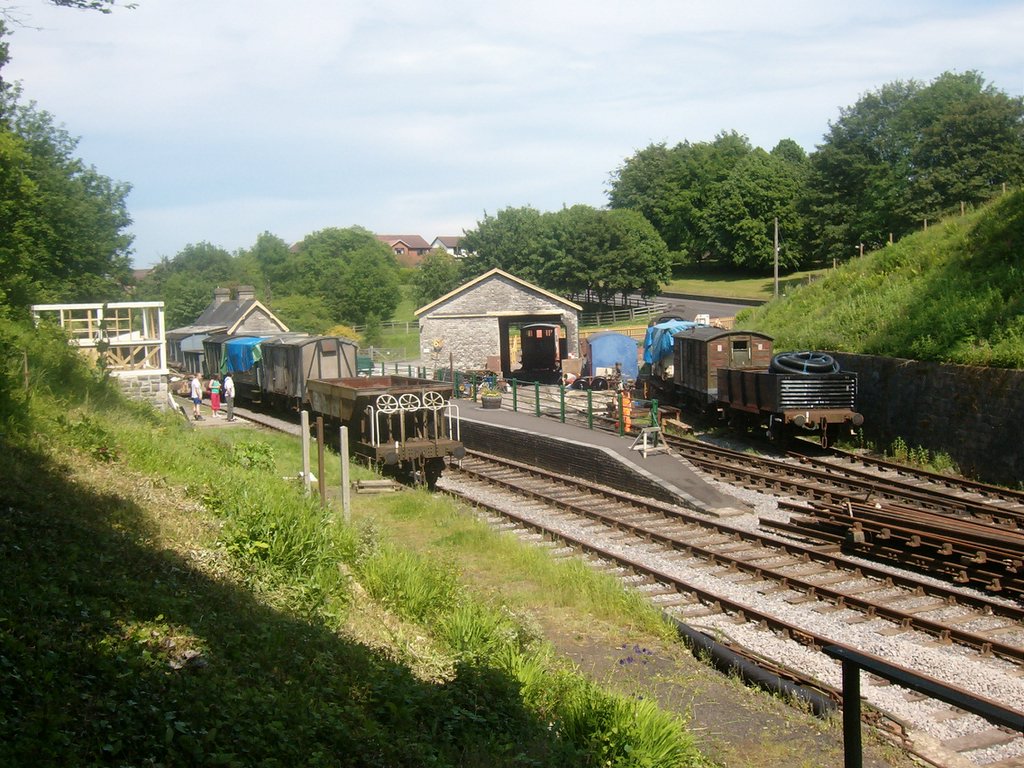
Welcome to the 'New Somerset and Dorset Railway'

The original Somerset and Dorset Railway closed very controversially in 1966. It is time that decision, made in a very different world, was reversed. We now have many councillors, MPs, businesses and individuals living along the line supporting us. Even the Ministry of Transport supports our general aim. The New S&D was formed in 2009 with the aim of rebuilding as much of the route as possible, at the very least the main line from Bath (Britain's only World Heritage City) to Bournemouth (our premier seaside resort); as well as the branches to Wells, Glastonbury and Wimborne. We will achieve this through a mix of lobbying, trackbed purchase and restoration of sections of the route as they become economically viable. With Climate Change, road congestion, capacity constraints on the railways and now Peak Oil firmly on the agenda we are pushing against an open door. We already own Midford just south of Bath, and are restoring Spetisbury under license from DCC, but this is just the start. There are other established groups restoring stations and line at Midsomer Norton and Shillingstone, and the fabulous narrow gauge line near Templevcombe, the Gartell Railway.

There are now FIVE sites being actively restored on the S&D and this blog will follow what goes on at all of them!
Midford - Midsomer Norton - Gartell - Shillingstone - Spetisbury


Our Aim:

Our aim is to use a mix of lobbying, strategic track-bed purchase, fundraising and encouragement and support of groups already preserving sections of the route, as well as working with local and national government, local people, countryside groups and railway enthusiasts (of all types!) To restore sections of the route as they become viable.
Whilst the New S&D will primarily be a modern passenger and freight railway offering state of the art trains and services, we will also restore the infrastructure to the highest standards and encourage steam working and steam specials over all sections of the route, as well as work very closely with existing heritage lines established on the route.

This blog contains my personal views. Anything said here does not necessarily represent the aims or views of any of the groups currently restoring, preserving or operating trains over the Somerset and Dorset Railway!
Showing posts with label Jeffery Grayer. Show all posts

Sunday, February 28, 2010

branching out


Two above courtesy Jeffery Grayer.


Courtesy Adrian Vaughan.

We'd like to welcome Steve Overthrow on board the New S&D team. He'd only discovered this blog a few days ago, has since joined and is now acting as track steward for Evercreech Junction to Burnham and the Bridgwater North and Wells branches. He will also be taking a keen interest in these branch affairs via a co-opted committee role. He has a long family history with the 'branch'.

We have always intended to restore the branches as well as the main line. All S&D branches served important towns and a city - Wimborne, Wells, Glastonbury, Burnham and Bridgwater - and also provided potential modern transport to many villages en route.

Restoration of the branch presents few physical obstructions and compared to the main line follows a very easy and lightly-engineered route. Early on I mooted restoration of Burnham-Highbridge or even an isolated (at first) route between Wells and Glastonbury as possible first steps towards restoration of the branch, mainly to find our feet as rail operators and to show that we are very serious. I can imagine Parry People Movers (of which more tomorrow) being ideal transport on these flat routes. The branch had a particular charm which I think will be recovered when it is restored - the landscape through which it runs has changed little during the four decades of temporary closure.
Posted by Picasa

Sunday, October 04, 2009

sturminster developments


(Bottom pic Jeffery Grayer 1967)

Fantastic news out of Sturminster, easily countering the dinosaur decision earlier this year to put houses on the trackbed! A new S&D group, STURMINSTER RAIL GROUP, has just launched. This is a totally independent group from the existing S&D groups on the route and they will be concentrating on the Sturminster Newton to Henstridge section with the intention of acquiring trackbed etc for the eventual restoration of trains to this part of the S&D. The New S&D would certainly commit to then restoring beyond Henstridge to Templecombe to link this section to the network, probably more quickly than if a group hadn't sprung up locally.

We would love to see similar groups appear all along the route, obviously working closely together but independently. It is precisely this local involvement and knowledge that will be the key to getting our job done as quickly as possible.

To contact this new group please email bournemouthwest@aol.com

Their opening statement goes as follows -

Hi! Just a quick mail to let you know that [we] are forming a group (Sturminster Rail group) which is primarily concerned with obtaining track bed of the former S&D in the Sturminster to Henstridge area.

Most of this track bed lies in open countryside, and the reaction of land owners will be, hopefully, positive for either selling/leasing the actual track bed across their land for rail usage again. There are no major problems on this particular route with the exception of Sturminster Newton town itself (where the deep cutting and road over bridges were filled in and destroyed respectively).

I hope we can all 'pull' together to realise this very important route is re instated wherever possible, and we, as a group will do all we can to ensure this outcome.
Posted by Picasa

Tuesday, August 11, 2009

freight - us and recession style


Most people think of the USA as pretty much backwards transport wise, but in fact as rail freight goes it is cutting edge. Most freight in the USA is moved by rail, not road.

So this piece, in an investment newsletter, caught my eye. To me it shows that rail is beginning to push itself to the front of the agenda, and also really does provide an indicator of economic activity, something our clogged roads can never do!


The No. 1 Reason I Don’t Trust This Market

BY TOM DYSON

The train drew round the bend and approached the crossing. The warning bells rang, and the barriers fell across the road. Then the engineer pulled four long blasts on his horn. Two 4,400-horsepower GE locomotives rolled past me at low speed ... bending the rails with their weight. This was an express container train bound for Chicago..."Shorter than normal," I thought. "And more empties than usual." Last week, I was on vacation in California. While I was there, I took the opportunity to gauge railroad activity. We drove a hundred miles beside Union Pacific's southern California mainline. This is one of the most important stretches of railroad in the country. It links the ports of Long Beach and Los Angeles with the eastern seaboard. I was expecting to see dozens of trains. We only saw two...

Then we stopped in Los Angeles to ogle the huge tangle of idled Union Pacific locomotives outside the Port of Long Beach. There must have been over 100 of them.

Freight trains move our most important basic materials around the country... like coal, fertilizer, steel, and container boxes. By watching the trends on America's freight railroads, you can get an excellent feel for the strength of the economy.

Right now, the railroads are hurting. Railcar loadings are down about 20% from last year's levels, railroads have abandoned half a million freight cars and idled over 5,000 locomotives. CSX Railroad has even closed a local freight yard near where I live in Florida and is using it entirely for storage.

Here's the thing: Since the stock market started rising in March, and the news from the housing market has improved, everyone's talking about economic recovery and the end of the recession. Last week, the non-farm payroll numbers came out. They were stronger than expected, sending the stock market to a new nine-month high... So why is business in the railroad industry still deteriorating?

This month's issue of Trains Magazine features a study of the number of locomotives held in storage by the major, "Class 1" railroads. The number of idled locomotives has swelled 57% between March and June...

Each quarter, Economic Planning Associates releases its Rail Car Overview report. In the second quarter, orders for new rail cars by railroads and shippers tumbled to 2,165 units from 2,374 units in the first quarter.And finally, the Association of American Railroads released its weekly report on rail car loadings last Thursday...

For the first seven months of 2009, total U.S. rail car loadings were down 19%, while container and trailer transportation fell 17.2%. All 19 major commodity categories tracked by the AAR saw car loads decline in July. The biggest declines were coal (down 9.9%), metals and metal products (down 47.7%), metallic ores (down 58.9%), and crushed stone and gravel (down 25.8%).The message from the railroads is, the economic recovery is a mirage. Things are going from bad to worse. Until you see the railroads turn around, you should continue to be suspicious of the rally in the stock market and the "green shoots" story in the news.
Posted by Picasa

Sunday, August 09, 2009

prepare the stocks


(Evercreech Junction 1968 Jeffery Grayer)

I was leafing through a copy of Colin Maggs' 'The Last Years of the Somerset and Dorset' and found the chapter on the run down of the line really interesting. The S&D was closed despite an assurance from the (surprise surprise!) Labour government of the day that no major railway closures would be implemented without a review of the Beeching Report. Evil witch (surely an oxymoron?) Barbara Castle went ahead and closed the line anyway, making it the longest line closed under Beeching. The bits about the poor people of Wellow and Shoscombe (in particular) having to cope without their trains was heartbreaking. At one point a minibus was put on to replace the trains! Nobody on this side of a lunatic asylum could ever claim that was progress. From having fast modern transport using a dedicated right of way they were suddenly thrown back a hundred years and forced to crowd into a six seater bus that was expected to crawl along little single track roads and then fight its way through the Bath traffic. (This is starting to sound like the Cambridge Guided Busway LOL!)

This madness needs to be dissected in the 21st century to find out what really inspired the closure of the original S&D. Perhaps a few of the perpetrators are still alive and can be called to account. The deliberate switching of freight to less direct routes, the deliberate running down of stations and rolling stock, the dreadful timetable that made almost every journey unbearable if not impossible, the refusal to consider track rationalising or using DMUs - the whole thing was a national disgrace.

It merely confirms to me that the S&D should never have closed, which basically means that there is now no reason for it not to be rebuilt.

Next year the new limited company charged with rebuilding and operating the line will be born. Hopefully the board will, as well as including prominent local businesspeople, have the Chairs of Midsomer Norton, Shillingstone, the New S&D and Washford as members.

At the same time I'll be working on 'The Case for the S&D' taking an incisive look at the hard-to-believe mischief used to deprive hundreds of thousands of people of their trains. And the now unarguable case for bringing them back.

I'm glad I'm on THIS side of the fence and not theirs!!
Posted by Picasa

Monday, August 03, 2009

more web content heading your way


Expect loads more content on the website over the next few weeks. We're trying to do a piece on each station, past, present and future. We're always happy to get any further info, especially on the current status of S&D stations. Visit the station part of the website here.
Posted by Picasa

Tuesday, June 30, 2009

glastonbury solution


(Glastonbury ca 1970 courtesy Jeffery Grayer)

No doubt you've all been watching the Glastonbury Festival over the last few years. Too mainstream by half for me, though a few acts were okay.

My point is that every year the festival causes traffic chaos around Pilton. Many festival goers do come in by train, but they have to be bussed from Castle Cary, making the road congestion even worse.

There is of course an ideal solution. Our trackbed actually currently serves as an internal road within the festival site! When the rails return - for Glastonbury is FAR too large a town to be left without trains - I'm sure the S&D will be more than happy to ferry passengers directly into the festival site, serving a special station. Not to mention bringing in much of the equipment etc in special freight trains. This is the future.
Posted by Picasa

Wednesday, March 11, 2009

evercreech junction 67/68


Three more superb Jeffery Grayer shots from 1967 and 1968. This time it's Evercreech Junction, one of the most emotive and iconic points on the old S&D. Even after closure the scale of the track layout and infrastructure at this rural spot is easy to see. Track was left in place partly for operational reasons, but also to allow the accountants to attribute unreasonable costs to the S&D to strengthen the very weak case for closure. Other scams included measuring traffic levels in school holidays and diverting freight traffic off the route, even when it was the most direct link. All of this stupidity will be investigated in the New S&D's work 'The Case for the S&D'. I've a finance background so I'm really looking forward to working on this part! I suspect that the morons engaged in this despicable activity think that time has covered up their crimes, but they're in for quite a shock ...

Jeffery's photos are from his superb if rather anachronistically titled book 'Sabotaged and Defeated' which should soon be available from the New S&D's online shop.
Posted by Picasa

Sunday, March 08, 2009

changes at Blandford


(top 1967 Jeffery Grayer)

Blandford is probably the largest and most important place on the southern S&D - and obscenely still off the network, despite this section retaining freight traffic until January 1969. The population is currently 8755 (census 2005), and grew over 100% between 1981 and 1991. The station site has some minor encroachments (and also some surviving track) but replacement shouldn't be too difficult, though freight facilities may have to be located elsewhere south of the passenger station.

I suspect that this will be the first section of the S&D to be restored to real trains (Blandford to Bournemouth) and that the section north to Templecombe may be the last section of the main line to be restored.

The town is surprisingly busy, with branches of all the main banks, chain stores, even a Holland and Barrett! It is madness that in the first decade of the 21st century it lacks any form of modern transport. That will certainly change now the New S&D is on the scene!
Posted by Picasa

Wednesday, March 04, 2009

demolition


Some more shots from Jeffery Grayer's book, Sabotaged and Defeated. They cover demolition work in 1967/68, with views from Shepton Mallet, Masbury and Evercreech Junction. What were they thinking of, pulling up a double track main line linking Britain's only World Heritage City with its premier seaside resort?

It will be great seeing all this destruction reversed, and the S&D fulfilling an indispensible modern transport role in the 21st century!
Posted by Picasa

Saturday, February 14, 2009

hymek in the snow


(Jeffery Grayer 2.12.1967)

Two classic post-closure shots from Jeffery Grayer's superb (if inaccurately titled!) Sabotaged and Defeated book. These show a Hymek working the milk traffic at Bason Bridge, on the truncated remains of the Highbridge-Evercreech Junction branch.

This date sticks in my mind as we had a big blizzard the same day down on the south coast in Sussex and I didn't have to go to school!
Posted by Picasa

Wednesday, February 11, 2009

radstock 1967, 1968 and 2006


(Courtesy Jeffery Grayer)


Radstock was a classic location with two separate railways cutting through the town, offering services to Bath, Bournemouth, Bristol and Frome, as well as loads of freight. The top three shots are of coal workings from Writhlington to Portishead. Back in 67 and 68 these ran via Pensford, but the 1968 flood led to the closure of the line due to flood damage at Pensford. Surprisingly the A37 road, which also suffered major damage, was NOT abandoned. After the flood the section of line between Radstock and Mells Road was reopened for the Portishead coal traffic, a much more roundabout route.

The New S&D plans to restore the link to Bristol eventually, hopefully the superb viaduct is not too damaged by the 1968 flood. I suspect it was an excuse to close this valuable line rather than anything too scary!

Car drivers used to whinge about being caught at the crossings in Radstock, but at least they had the option of using the trains. Nowadays, in this strange hiatus between trains, it can sometimes take 20 minutes just to negotiate the double roundabouts near where the crossings used to be. As usual we have gone backwards.
Posted by Picasa

Friday, January 02, 2009

message board is back!


(Combe Down 1968, courtesy Jeffery Grayer)

I've only just realised that when I changed the layout of this blog the message board link was lost!

As 2009 is going to be such a momentous year for the S&D I'm sure the message board facility will be much used, so to access it please click here!
Posted by Picasa

Friday, October 05, 2007

very cross rail


(copyright Jeffery Grayer. Midford 1967)

So the government are planning to waste £16 billion on yet another cross London railway, which will do little more than connect east and west of a city already teeming with public transport options, a city that will probably be uninhabitable within 50 years.

Just imagine what that £16 billion could do in the real world. Restore the S&D for a start, rebuild the whole Waverley route, not just a little stub at the northern end, restore the whole Great Central, Bere Alston to Okehampton, branches to Bude, Padstow, Lyme Regis, Devizes, Midhurst, Gosport, Ringwood, Wimborne and a dozen other places stupidly currently off the rail map, and probably leave about £5 billion for tram systems in about 20 towns and cities!

At the very least the government should grant automatic planning permission for all rail reinstatements coupled with compulsory purchase powers for any land needed for new railways.

Just let us get on with the job!
Posted by Picasa

Wednesday, September 19, 2007

combe down open again!


(Photo: Jeffery Grayer)

It's like buses - you wait for a Combe Down Tunnel walk for years then two come along together ...

It's open on 27th September thanks to our friends in the Two Tunnels Group.

For more info click here.
Posted by Picasa

Tuesday, June 19, 2007

museum


The museum should be open within a year, the first few tenders are now going in for the work. We received just short of £50,000 from the Heritage Lottery Fund for this work.

Once it's built the museum will become a focal point for both local and railway historians. It will be state-of-the-art, not some musty old collection of relics. It will hopefully become the primary resource for all S&D historians.

Remember that the history of the S&D did not end in 1966! The above shot is of Wellow in 1980. The 'closed' period of the S&D will become a fascinating idiosyncracy for historians in 50 years time, when trains are again steaming from Bath to Bournemouth. Please consider donating pictures you have of the line, both before and after 1966, for use in the museum archive - the more unusual the better! The success of Jeffery Grayer's book 'Sabotaged and Defeated' proves that the 'closed' period has a fascination of its own, as does volume 3 of the TVP series on the S&D, which concentrates on the dismantling of the route. For every classic Ivo Peters' shot, there must be a thousand other shots of the line from a different perspective. Let's flush them all out!

Donations of photos/negatives/film etc can be made at the station on any Sunday or Monday. We will take the utmost care of them and ensure that they reach a wider public over the coming years.
Posted by Picasa

Wednesday, June 21, 2006

the benefits of foresight


It seems odd that it’s taken forty years for the reversal of the idiotic closure of the S&D to start, and it’s worth looking at some of the possible reasons why.

There’s a story (surely apocryphal) that the whole S&D was offered to anyone interested in 1966 for £50,000! That’s line, stations, signalling, the lot. Even if true would a privately-owned S&D have been viable back in the sixties? The preservation movement was in its infancy, rail was (incredibly) seen as a dying technology, and marketing was unheard of. And at the same time steam was still reasonably common on British Railways, so steam on the S&D wouldn’t have been that much of a novelty. On top of the £50,000 locos and stock would have had to be found, and at that time about the longest preserved line was the Festiniog at 7 miles, the longest standard gauge was the Bluebell at 4 miles. A 100-mile preserved line would have been impossible to run economically - in 1966.

As the sixties became the seventies rail preservation was beginning to find its feet, the Dart Valley and Keighley and Worth Valley were added to the small list of standard gauge lines, and a small preservation set-up was emerging at Radstock, with the seemingly very reasonable and easily-achievable plan to restore the (in-situ) line to Writhlington.

Its failure in the anti-rail 70s surely left a bit of a cloud hanging over the S&D. Attempts (mainly pipe-dreams) to set up other schemes all fell through, without even laying track. The 80s were the real low-point for the S&D, not an inch of track remained and the clock was ticking.
So how could the finest line in the country be allowed to reach such a state? Surely with the huge love and support of rail enthusiasts and local residents at least part of the S&D could have been reinstated, even if only as a tourist attraction? Less worthy lines were being restored all over the country, the Great Central was restoring a double-track main line, the West Somerset turned a decaying branch line into a 20-mile plus tourist trap, even once empty trackbeds were being restored.

Was it the sheer magic of the S&D that frightened people off? Surely those coffin-chasers in the 60s actually quite liked the idea of being the ’last ever’ passengers on the line, there was perhaps a poignant grandeur in decaying stations fading in the mist, the ‘Withered Arm’ generation prefering the easy route of fondly remembering the recent past rather than facing up to the sheer hard work of restoring one of those dead routes? Perhaps they still see the next generation, those of us born too late to travel on and know the original S&D, as somehow inferior to them? Or perhaps there were simply too many other distractions - established steam railways, music, women, cheap sangria etc?

The world has changed so much in the last thirty years that perhaps it’s difficult for any of us to really get into that downbeat mindset any longer. Rail is in the ascendant, roads are coughing their last as the oil runs out, people want to live quieter, friendlier, more connected lives. Doors are opening for us all along the S&D.

Perhaps the S&D needed that period of temporary closure from 1966 to 2007 to gain an insurmountable mythic status where the iconography of Ivo Peters melds with the pathos of Jeffery Grayer, where Mike Arlett’s dulcet if somewhat pessimistic tones are replaced by the guitars of Arctic Monkeys to transform a whisper into a shout that ‘we are back, and this time it’s for good!’ Posted by Picasa