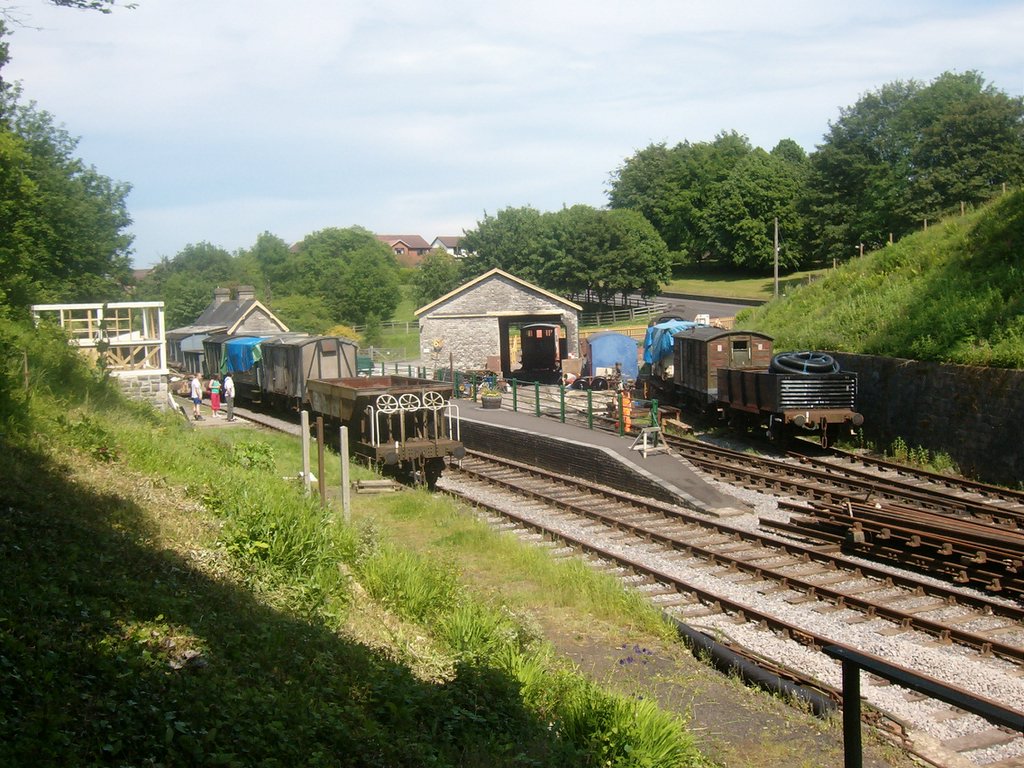
Welcome to the 'New Somerset and Dorset Railway'

The original Somerset and Dorset Railway closed very controversially in 1966. It is time that decision, made in a very different world, was reversed. We now have many councillors, MPs, businesses and individuals living along the line supporting us. Even the Ministry of Transport supports our general aim. The New S&D was formed in 2009 with the aim of rebuilding as much of the route as possible, at the very least the main line from Bath (Britain's only World Heritage City) to Bournemouth (our premier seaside resort); as well as the branches to Wells, Glastonbury and Wimborne. We will achieve this through a mix of lobbying, trackbed purchase and restoration of sections of the route as they become economically viable. With Climate Change, road congestion, capacity constraints on the railways and now Peak Oil firmly on the agenda we are pushing against an open door. We already own Midford just south of Bath, and are restoring Spetisbury under license from DCC, but this is just the start. There are other established groups restoring stations and line at Midsomer Norton and Shillingstone, and the fabulous narrow gauge line near Templevcombe, the Gartell Railway.

There are now FIVE sites being actively restored on the S&D and this blog will follow what goes on at all of them!
Midford - Midsomer Norton - Gartell - Shillingstone - Spetisbury


Our Aim:

Our aim is to use a mix of lobbying, strategic track-bed purchase, fundraising and encouragement and support of groups already preserving sections of the route, as well as working with local and national government, local people, countryside groups and railway enthusiasts (of all types!) To restore sections of the route as they become viable.
Whilst the New S&D will primarily be a modern passenger and freight railway offering state of the art trains and services, we will also restore the infrastructure to the highest standards and encourage steam working and steam specials over all sections of the route, as well as work very closely with existing heritage lines established on the route.

This blog contains my personal views. Anything said here does not necessarily represent the aims or views of any of the groups currently restoring, preserving or operating trains over the Somerset and Dorset Railway!
Showing posts with label Festiniog. Show all posts

Tuesday, April 10, 2012

where it all started


If you ever wondered where the idea of a rebuilt modern S&D came from you need look no further than the constitution of the SDRHT at Midsomer Norton - 'to assist with any 21st century reconstruction as part of the national network or as a heritage railway'.

Like many other New S&D members I am also a life member at Midsomer Norton. They have always been an incredibly forward-looking group and have inspired all of us working towards rebuilding the S&D as a real railway. They have worked wonders at Midsomer Norton in seemingly impossible circumstances, the site was once earmarked for sub-standard 20th century housing! Yet even 20 years ago, whilst being told by the dinosaurs 'Midsomer Norton will be demolished and vanish forever' they had the foresight to plant the idea of a fully restored line, an icon buried deep in their constitution yet, in its own way, every bit as powerful as the 'Perchance it is not Dead but Sleepeth' wreath placed on the buffers of the L&B line at Barnstaple Town station in 1935, or the Festiniog leaving Blanche at Blaenau years before the rails reached her.

Everyone involved in restoring the S&D; whether a ticket office person at Midsomer Norton, a narrow gauge signalman at Gartell, the shop staff at Shillingstone, the people restoring old carriages at Washford, the Seales clearing the platform at Midford, Dean Cockwell powering ahead the taking over of Spetisbury, the New S&D legal team studying CPOs, Environmental Assessments or trackbed arrangements and all the thousands of others supporting and rebuilding this line are all working towards the same thing - making the inevitable possible!

Monday, February 20, 2012

a different view


I received this as an email today and would welcome comments in the comments section. Keith's vision is of a narrow gauge railway on a small part of the S&D mixing modern and heritage aspects.

I have been following progress of the various projects covering the
S&D, plus a few more in selected places over the south and east of the
country. I am at present living most of the time in Portugal, although that
might change in the coming months.


I was fortunate to view at first hand and from the earliest days the
revival of the Great Central and the Watercress lines, and also made frequent
stopovers/detours to the Bluebell Line during my time as a salesman. I often
tried to plan my route for the week with lunch time breaks near railways, both
preserved and those in mainline service.


I have now retired, although am busier than ever, involved in a number of
writing projects.However, in a rather full and varied career/careers I was also
noted for innovation/challenging the status quo, but always with a practical and
viable solution. My projects nearly always came to fruition because they were
'do-able'.

The S&D was 100 miles long, plus probably the same again in the
branchlines. To return that to full running would mean two miles of track a year
for 50 years, or five miles a year for 20 years, or 10 miles a year for 10
years. We only have to look at the experiences of the Great Central, the
Bluebell and the Watercress to realise how difficult it is to build, maintain
and manage relatively short lengths of track, and also how long it takes to
build even short extensions. I have recently watched some videos of the track
renewal work at the Bluebell. This is major engineering, requiring all the
skills, manpower, and heavy equipment needed to do the job, and in reality it is
only upgrading the railway, and the average passenger would see no difference or
benefit.


The Watercress did manage to get to Alton, but it took them 20 years. The
Bluebell still cant reach East Grinstead after 50 years, although 2012 maybe the
year. The Swanage line cant reach Wareham because of signalling and a level
crossing, although that might change this year, with the cash injection from
BP.


The timescale on all these things is measured in decades. In 1970 I was
surprised to see that 71000, Duke of Gloucester had survived the cutters torch
and was stabled at Loughborough. It wasn't in bad condition and I was told they
hoped to get it back running in around five years. One pessimist thought 10
years. In fact it took 20 years and probably 20 times the original cost
estimate.


So, how does all this impact on the S&D. Well the various projects are
moving forward and it is obvious that within five years there will be a number
of stations restored to their 1950s glory, and that there will be a small but
perfectly formed preserved railway at Midsummer Norton, and another at
Shillingstone. Gartell will be running for fun on a limited number of weekends.
All three will slowly grow from their current boundaries but nothing that is
going to see either a service to the community or an impressive stage for a
hardworking steam loco.


But there will be no more track, and with little prospect of more given the
current economic climate and the practicalities of running a railway.


Yesterday I watched a short youtube video of the old BBC S&D program
with Ivo Peters and it followed the route up to Midford, describing it as one of
the prettiest routes in the country. Few people would disagree I think. I am
also following the dramatic progress of the Two Tunnels route, which is planned
to be complete by this time next year, and will potentially put thousands of
walkers and bikers on to the platform at Midford.


So I looked at what was practical and what could be achieved. I looked at
places where there has been success over the kind of distances that will need to
be covered to get out of Bath and into the heart of Somerset, to Midford,
Radstock and to MSN.


There are two obvious and most successful models that ought to be looked
at, and both have very obvious similarities to the section between MSN and Bath.
The two lines I am talking about are the Romney Hythe and Dymchurch, and the
Ffestiniog line. Both are practical railways that cover substantial distances,
and both have showed long term sustainability.


Both, of course are narrow guage, but the economies of scale have so many
advantages that they are overwhelming. They also fit beautifully into the
scenario that is becoming the reality of the old S&D trackway.


Multiuse of the 'two tunnels' route by full size trains would be
problematic in the extreme, but a 2ft line would offer the perfect solution. The
scale makes it manageable, with everything from the permanent way to the rolling
stock. In particular the loading gauge on the bridges is not a problem.
Everything then becomes possible and practical and likely to be sustainable. It
also offers not just a wonderful tourist attraction but also a means of
transport into that most inaccessible city, Bath. It is a win, win, win
solution, and I could see very few detractors.


Because infrastructure costs are so greatly reduced the money and effort
can go into laying and maintaining the track. How difficult would it be to
create a 20 mile full scale railway from Bath to MSN, and how much easier to do
it in a smaller scale. The route breaks down beautifully into three sections,
each 6-7 miles long, and I could easily imagine train services out of Bath as
far as Midford in 3-5 years. If the money was available that would be an easy
task. MSN in ten years would be a certainty, and if phase one was a success then
probably much quicker.


So restoring the S&D as a working railway then becomes a feasible
project in everyones lifetime. Mix new technology with old, and so all the ideas
about engineering workshops and innovative motive power systems become a
practical reality. I think that would bring out the volunteers, because everyone
could help.


Full size railways are for heavy engineers and are out of the range of the
pockets of anyone involved, especially in these hard economic times. I'm sure a
visit to North Wales or to Dungeness would demonstrate this is a practical
solution and would have the wholesale support of both the people, and the
Councils that have an active interest in restoring the route.


Keith Browning

Friday, October 29, 2010

the impossible takes a few years longer


Firstly some little rails in a UK public roadway and look, nobody is getting squashed. This was reportedly the first rail movement since new colourlight signals put in at Britannia Bridge, you can see white paint going over the rail crown. The diesel loco is called Moelwyn and I think was one of the American Baldwins made for the WW1 trench warfare meat mincer.

This picture shows how history can run in reverse as the original track here was rooted out in 1960's when it got in the way of increasing road vehicle traffic. It was only left in until then so the armoured Simplex loco could visit the local petrol station when it required refuelling, nobody imagined the track could ever have a serious use again. (Picture via Festiniog website, via Brian Clarke)


The natural pessimists among us always tell us 'it can't be done'. It doesn't even have to be a big thing - to them nothing is possible. My mum and dad used to say the same thing - which is probably why I am of the polar opposite persuasion! The classic was the person who said that Midsomer Norton would never reach Chilcompton because there was 'a garden in the way'!! I'm sure psychologists would have a field day with 'em. Needless to say the S&D revival has brought them out in their droves!

So this is for them. Of course the Welsh Highland revival could never happen either LOL! And the business case for this is minimal compared to the S&D case ...

Original story.

The final step in the creation of Britain's longest narrow gauge railway will be taken this weekend.For the first time, the Welsh Highland Railway will carry passengers along the whole length of the newly-laid line between Caernarfon and Porthmadog.

When linked up with the Ffestiniog Railway at Porthmadog's Harbour Station, it will be possible to travel by steam for almost 40 miles through the Snowdonia countryside.

The new line will open to passengers in April 2011, but this weekend's trips have been laid on especially for those who've helped contribute more than £2m towards the restoration work and the volunteers who gave up their time to lay the track.
WEEKEND TIMETABLESaturday, 30 October, 9am, first train leaves Caernarfon, crossing Britannia Bridge, Porthmadog, 11.25am.

Second train departs 11am, arriving at Porthmadog 1.40pm.

Trains return to Caernarfon at 12.50pm and 2.55pm.

Sunday, 31 October, 1.15pm, train departs Porthmadog hauled by Lyd, the world's newest steam locomotive, built at the railway's own workshops.

Other enthusiasts can watch the trains running down the tramway section on Porthmadog's High Street for the first time since the original railway closed 79 years ago.

The trains will also cross over the Network Rail line at Britain's only standard gauge/narrow gauge level crossing.

"It will have the first train running the length of the line with genuine passengers," said Andrew Thomas, spokesman for the Ffestiniog and Welsh Highland Railway (FWHR) who are responsible for all the track between Caernarfon and Blaenau Ffestiniog.

"The journey will currently take around two hours, because it takes a few years for the new track to bed in. Eventually, we will be able to run at the maximum of 25mph, and the journey will take one and a half hours."

The work on this line began in the early 1990s and has cost £28 million in total. Partly funded by grants, the rest of the money was raised by donations from sponsors and the public.

Over 1,000 volunteers have helped lay the track, and Andrew is delighted they and their families will be the first to enjoy the trip.

"Everyone always says the best part of the line is through the Aberglaslyn Pass, because it's much better than driving it in a car," said Andrew.
Economy"But my favourite part is the flat section down towards Porthmadog, mainly because you're surrounded on three sides by mountains. You have a majestic, panoramic view of Cnicht and Snowdon; it's really impressive."

The FWHR say the steam railway generates up to £15m a year for the Gwynedd economy and creates an estimated 350 jobs in the area.

Special sherry and mince pie trips from Porthmadog to the Glaslyn Valley will be held from early January when the Ffestiniog line will be closed for maintenance work for six weeks.

There will also be trips from Porthmadog to Caernarfon during February half term.

Thursday, April 10, 2008

cheap solution to blockages!


Transition Transport UK now also has a blogsite
to complement its facebook presence. I promise future posts here will be S&D first and foremost but this is such a great video I thought it might give the S&D ideas where the trackbed is a bit difficult - run 9Fs down the middle of the street! Cheap, easy and spectacular, and conflict with road traffic will become less and less of a problem as cars and lorries disappear from our roads!

This will soon be a common sight in Porthmadog when the Welsh Highland links with the Festiniog on street - using steam!

Wednesday, June 21, 2006

the benefits of foresight


It seems odd that it’s taken forty years for the reversal of the idiotic closure of the S&D to start, and it’s worth looking at some of the possible reasons why.

There’s a story (surely apocryphal) that the whole S&D was offered to anyone interested in 1966 for £50,000! That’s line, stations, signalling, the lot. Even if true would a privately-owned S&D have been viable back in the sixties? The preservation movement was in its infancy, rail was (incredibly) seen as a dying technology, and marketing was unheard of. And at the same time steam was still reasonably common on British Railways, so steam on the S&D wouldn’t have been that much of a novelty. On top of the £50,000 locos and stock would have had to be found, and at that time about the longest preserved line was the Festiniog at 7 miles, the longest standard gauge was the Bluebell at 4 miles. A 100-mile preserved line would have been impossible to run economically - in 1966.

As the sixties became the seventies rail preservation was beginning to find its feet, the Dart Valley and Keighley and Worth Valley were added to the small list of standard gauge lines, and a small preservation set-up was emerging at Radstock, with the seemingly very reasonable and easily-achievable plan to restore the (in-situ) line to Writhlington.

Its failure in the anti-rail 70s surely left a bit of a cloud hanging over the S&D. Attempts (mainly pipe-dreams) to set up other schemes all fell through, without even laying track. The 80s were the real low-point for the S&D, not an inch of track remained and the clock was ticking.
So how could the finest line in the country be allowed to reach such a state? Surely with the huge love and support of rail enthusiasts and local residents at least part of the S&D could have been reinstated, even if only as a tourist attraction? Less worthy lines were being restored all over the country, the Great Central was restoring a double-track main line, the West Somerset turned a decaying branch line into a 20-mile plus tourist trap, even once empty trackbeds were being restored.

Was it the sheer magic of the S&D that frightened people off? Surely those coffin-chasers in the 60s actually quite liked the idea of being the ’last ever’ passengers on the line, there was perhaps a poignant grandeur in decaying stations fading in the mist, the ‘Withered Arm’ generation prefering the easy route of fondly remembering the recent past rather than facing up to the sheer hard work of restoring one of those dead routes? Perhaps they still see the next generation, those of us born too late to travel on and know the original S&D, as somehow inferior to them? Or perhaps there were simply too many other distractions - established steam railways, music, women, cheap sangria etc?

The world has changed so much in the last thirty years that perhaps it’s difficult for any of us to really get into that downbeat mindset any longer. Rail is in the ascendant, roads are coughing their last as the oil runs out, people want to live quieter, friendlier, more connected lives. Doors are opening for us all along the S&D.

Perhaps the S&D needed that period of temporary closure from 1966 to 2007 to gain an insurmountable mythic status where the iconography of Ivo Peters melds with the pathos of Jeffery Grayer, where Mike Arlett’s dulcet if somewhat pessimistic tones are replaced by the guitars of Arctic Monkeys to transform a whisper into a shout that ‘we are back, and this time it’s for good!’ Posted by Picasa